
Security audits, managed crowdsourced security platforms, and open bug bounty programs are often treated as interchangeable approaches to security testing. In practice, they serve different roles. While crowdsourced approaches and bug bounty programs are effective at uncovering vulnerabilities in deployed systems, both remain inherently exploratory rather than systematic. Security audits address a different problem, providing a structured and comprehensive analysis of system design, assumptions, and risk.
A well-planned security strategy requires understanding how these approaches differ and where each is most effective.
Three Approaches
Security Audits
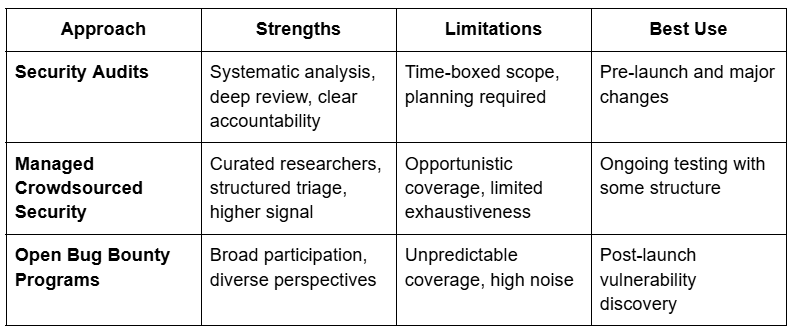
Security audits are structured, time-bounded engagements designed to provide a comprehensive analysis of a system’s security. The scope is defined in advance, allowing auditors to systematically review architecture, assumptions, and implementation details. This structured approach ensures that critical components are examined deliberately rather than incidentally.
Security audits are particularly valuable early in the development process, where design assumptions and architectural decisions can be evaluated before deployment. They also allow organizations to have specialized experts review complex components in depth, helping identify vulnerabilities and invalid assumptions before they become embedded in deployed systems.
This makes audits particularly well suited for assessing design decisions, identifying systemic risks, and providing assurance before deployment or after significant changes.
For a more detailed discussion of audit preparation, methodology, and the interpretation of audit results, see our related posts on this topic.
Managed Crowdsourced Security
Managed crowdsourced security platforms introduce structure to the traditional bug bounty model by curating participants and providing program management and triage. This typically results in higher signal, as submissions are filtered and coordinated, and organizations can engage a selected group of researchers with relevant expertise. Crowdsourcing has emerged as a valuable solution, incentivizing ethical hackers to report critical bugs.
However, the underlying model remains exploratory: Researchers decide what to investigate, and coverage is driven by individual interest rather than a predefined plan. While this approach can be effective at uncovering real-world vulnerabilities in deployed systems, it does not guarantee comprehensive or systematic analysis of the entire system.
Open Bug Bounty Programs
Open bug bounty programs invite anyone to participate, offering rewards for valid vulnerability reports. This openness can bring a wide range of perspectives and techniques, occasionally surfacing issues that might not emerge in more structured environments.
At the same time, this model carries the highest variability. Participation, coverage, and outcomes are inherently unpredictable, and there is no guarantee that critical areas will be examined. Open bounties are most effective on mature, publicly accessible systems where the attack surface is already well defined. Coverage can be shaped by researcher incentives, including reward types, reward levels, and the popularity or adoption of the system, such that some areas receive significant attention while others may be largely overlooked.
Early-stage projects or those with smaller teams may face additional challenges using this method. Development teams are often focused on implementing core functionality and system stabilization, leaving limited capacity to manage incoming reports, triage findings, and complete remediation. Similarly, newer or less widely adopted systems may attract less researcher attention, reducing the effectiveness of open bounty models.
As a result, open bug bounties are best understood as a mechanism for opportunistic vulnerability discovery rather than a method for assessing overall system security.
The differences between these approaches become clearer when viewed side by side:
Where Each Approach Fits in the Software Development Lifecycle (SDLC)
Another important distinction between these approaches is the stage at which they can be applied and the conditions under which they are used. The stage of development and the accessibility of the system both play a significant role in determining which approach is appropriate.
Security audits can be performed at any stage of the SDLC, including, before a system is deployed. They are often conducted on private codebases or public codebases that are not yet in use, under controlled conditions, allowing auditors to review architecture, design decisions, and implementation details. This makes audits particularly valuable for supporting a security-by-design approach, where risks are identified and addressed as part of the development process rather than after deployment.
Crowdsourced approaches, including, managed platforms and open bug bounty programs, generally require a running and accessible system. Researchers need a target to interact with, whether through a live deployment, a staging environment, or open-source code. Where systems are not public, access is typically restricted to invited and vetted researchers under agreed terms. This necessarily limits participation and requires organizations to define the scope of access in advance. As a result, these approaches are most effective once a system is operational or nearing deployment.
While managed crowdsourced programs can accommodate restricted access through vetted participants and agreed terms, open bug bounty programs cannot. Systems that require confidentiality or controlled disclosure are therefore not appropriate for open bug bounty models.
Taken together, these factors indicate that audits and crowdsourced testing are typically applied at different stages. Audits are well suited to early and pre-release analysis, while crowdsourced approaches are most effective for ongoing testing of deployed systems.
AI Benefits Defenders and Attackers Simultaneously
Artificial intelligence is rapidly changing every approach discussed here, including professional security audits, managed crowdsourced testing, and open bug bounty programs. AI-assisted tooling can accelerate vulnerability discovery, lower barriers to participation, and help researchers and auditors analyze systems more quickly. However, many of these same capabilities are also available to malicious actors, increasing both the scale and speed at which potential attacks and security reports can be generated.
This shift creates new operational challenges. AI can generate large volumes of findings, but not all findings represent meaningful vulnerabilities. Duplicate reports, low-signal submissions, incomplete exploit chains, and theoretical issues all increase the burden on teams responsible for triage and remediation. As AI lowers the cost of generating reports, the importance of human expertise, contextual understanding, and effective prioritization becomes even more critical.
AI is proving valuable as a tool for security work, but it does not replace architectural analysis, threat modeling, or the ability to assess real-world impact. Identifying potential issues is only one part of security evaluation. Understanding exploitability, determining severity, and implementing effective fixes still require experienced human judgment.
- AI increases the speed of discovery, but not necessarily the quality of understanding.
- Not every bug identified by AI represents a meaningful security risk.
- The ability to generate findings is not the same as the ability to assess impact.
- AI can assist security evaluation, but it does not replace architectural understanding or threat modeling.
- As AI lowers the barrier to report generation, the importance of effective triage and human expertise increases.
While AI is already reshaping security evaluation, its long-term impact remains uncertain. Regulation may alter how AI-assisted tooling can be used in both offensive and defensive security work. Nonetheless, AI has already changed the security landscape by accelerating vulnerability discovery, increasing report volume, lowering barriers to participation, and altering attacker capabilities. Some of these changes have strengthened security practices, while others have introduced new operational and organizational challenges. What remains clear is that AI is changing the economics and pace of security work faster than the industry has fully learned to assess it.
Cost Structure Across Approaches
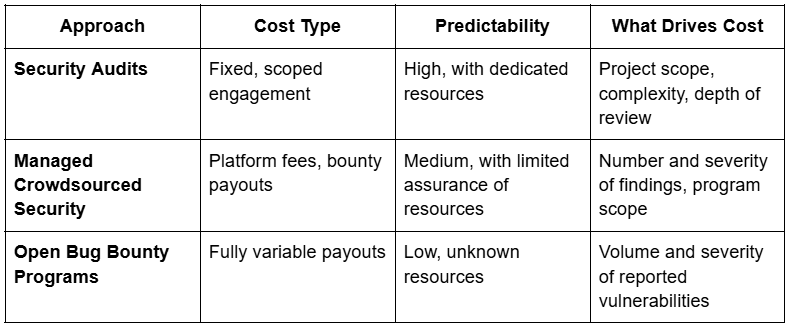
Cost is another area where these approaches differ significantly. Security audits are typically scoped and priced in advance, providing a clear understanding of both cost and coverage. Crowdsourced approaches, including managed platforms, combine platform fees with variable bounty payouts, making total cost more difficult to predict. Open bug bounty programs are even more variable, with costs influenced not only by the severity of discovered vulnerabilities, but also by the volume of reports submitted and the operational effort required to review and triage them. As AI-assisted tooling lowers the barrier to participation and report generation, organizations are facing increasing overhead from duplicate, low-signal, or otherwise non-actionable submissions. A bug is not always an exploitable bug. As a result, what appears less expensive upfront may become more costly once internal triage, remediation efforts, and unpredictable bounty payouts are factored in.
These differences in cost structure can be summarized as follows:
Complementary, Not Interchangeable
Security audits, managed crowdsourced security, and open bug bounty programs are not competing approaches, but complementary ones. Each plays a distinct role in identifying and mitigating risk, and each operates under different assumptions about coverage, depth, and responsibility.
Crowdsourced approaches are effective at uncovering vulnerabilities in deployed systems, particularly over time and under real-world conditions. Open bug bounties add an ongoing, opportunistic layer on top of both. Security audits, by contrast, provide a structured and accountable assessment of system design, implementation, and risk at defined points in time.
Understanding how and when to use these approaches is essential. Each should be selected according to the security question being asked, the stage of the system, and the level of assurance required. In contexts where systematic assurance is needed, a security audit remains indispensable.